

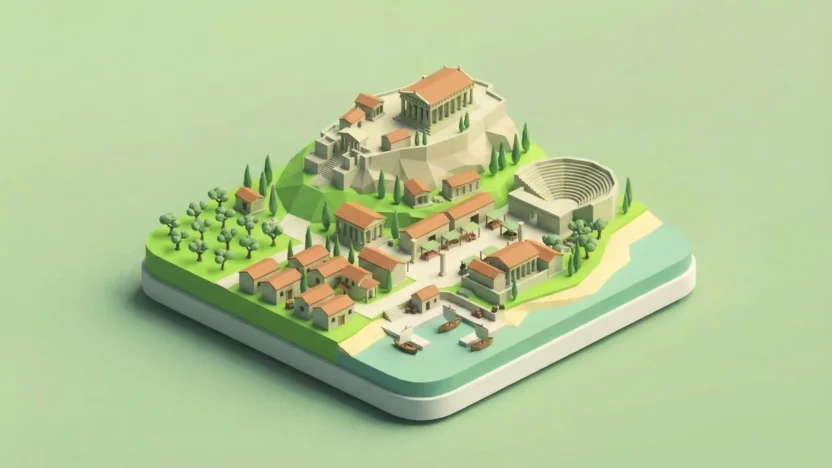
La Grecia antigua no era un solo lugar, sino muchos. Atenas valoraba el debate y la vida del intelecto; Esparta, la disciplina y las artes de la guerra; Corinto se enriqueció con el comercio; Tebas rumiaba en silencio, y luego golpeaba. Cada ciudad-estado desarrolló su propio temperamento, su propia respuesta a la pregunta de cómo vivir mejor. La rivalidad entre ellas produjo filosofía, democracia, algunas de las mejores esculturas de la historia —y una buena dosis de derramamiento de sangre.
Estas diferencias perduran, no en constituciones ni en mármol, sino en el carácter humano. Algunos discuten; otros actúan. Algunos buscan riqueza; otros buscan gloria. La polis en la que habrías prosperado dice algo sobre quién eres. Esta prueba pretende descubrir cuál.
35 Questions · English
Esta prueba se nutre de principios psicométricos y una buena dosis de historia clásica. No te dirá, por desgracia, si habrías sobrevivido a la batalla de las Termópilas. Pero puede revelar algo sobre cómo piensas, qué valoras y dónde residen tus instintos —al emparejarte con una de las ciudades-estado que un día salpicaban el Egeo.
He aquí una breve guía de cada una:
Athens
Athenians talked—endlessly, brilliantly, and sometimes to their own detriment. The city that gave the world Socrates, Plato, and the democratic assembly was a place where ideas mattered, arguments were sport, and a well-turned phrase could make a reputation. Art flourished; so did litigation. If you are drawn to debate, sceptical of received wisdom, and inclined to believe that most problems yield to sufficient thought, you may have an Athenian temperament. The risk, as Socrates discovered, is that not everyone appreciates being proved wrong.
Sparta
Spartans were not much for conversation. While Athens debated, Sparta drilled. The city produced no philosophers of note, few poets, and a great many soldiers who did exactly what they were told. Boys left home at seven to begin training; men ate at communal messes until old age. The result was a military machine of terrifying efficiency and a society with little room for personal ambition—or personal comfort. If you value discipline over creativity, trust deeds more than words, and believe that duty to the group outweighs individual desire, you may be Spartan at heart. Just do not expect much praise. A Spartan mother’s famous farewell to her son was brief: return with your shield, or on it.
Corinth
Corinth sat on an isthmus and grew rich from the tolls. While Spartans fought and Athenians argued, Corinthians traded—with anyone, in almost anything. The city’s ports faced both east and west; its merchants spoke many languages and worshipped profit with considerable devotion. Corinthian bronzes were coveted across the Mediterranean; Corinthian morals, less so. If you are pragmatic, commercially minded, and unbothered by what purists think, you may share something with this city of dealers and makers. Corinth understood what Athens sometimes forgot: ideas do not pay for themselves.
Thebes
Thebes waited. For centuries it stood in the shadow of Sparta and Athens, nursing grievances and biding its time. Then, in 371 BC, the Theban general Epaminondas crushed the Spartans at Leuctra and upended the Greek world. The city’s glory was brief—Alexander the Great razed it a few decades later—but the Theban temperament endures: patient, proud, and harbouring a certain taste for the dramatic. Its myths were appropriately tragic; Oedipus called Thebes home. If you are the type to hold your fire until the moment is right, to resist dominant powers on principle, and to remember slights long after others have forgotten, you may recognise something of yourself here. Thebans were not first, but they made sure they were remembered.
Delphi
Delphi was less a city than an institution. Perched on the slopes of Mount Parnassus, it housed the Oracle—a priestess who inhaled volcanic vapours and uttered prophecies that kings and generals crossed the Greek world to hear. The advice was rarely clear. When Croesus of Lydia asked whether he should attack Persia, the Oracle replied that he would destroy a great empire; he did, but it was his own. “Know thyself” was carved at the temple entrance, though visitors usually came hoping to know something else. If you are more observer than participant, drawn to ambiguity rather than certainty, and inclined to answer questions with better questions, Delphi may suit you. Just do not expect gratitude. Those who speak in riddles are respected, but seldom liked.
Argos
Argos claimed to be the oldest city in Greece, and made sure everyone knew it. While other cities boasted of recent victories, Argos pointed to its mythological pedigree: Perseus was a native son; Agamemnon ruled from nearby Mycenae. The sculptor Polykleitos, who defined the ideal proportions of the human body, worked here. Yet for all its heritage, Argos rarely dominated. It feuded with Sparta, stayed neutral when others fought, and survived by knowing when to assert itself and when to keep quiet. If you take pride in where you come from, value craft over spectacle, and prefer endurance to fleeting glory, you may have Argive instincts. Argos never ruled Greece—but it is still there, which is more than Sparta can say.
Rhodes
Rhodes built a statue so large it became one of the Seven Wonders of the World. The Colossus stood for just 56 years before an earthquake toppled it, but the ambition it represented was no accident. Positioned where the Aegean meets the eastern Mediterranean, the island grew wealthy from shipping and wrote the maritime laws that governed trade for centuries. Rhodians were sailors and diplomats, more comfortable negotiating between great powers than fighting them. If you prefer to connect rather than conquer, think in terms of networks rather than borders, and believe that a well-placed harbour beats a well-drilled army, you may have something of Rhodes in you. The Colossus fell, but the trade routes endured—which mattered more.